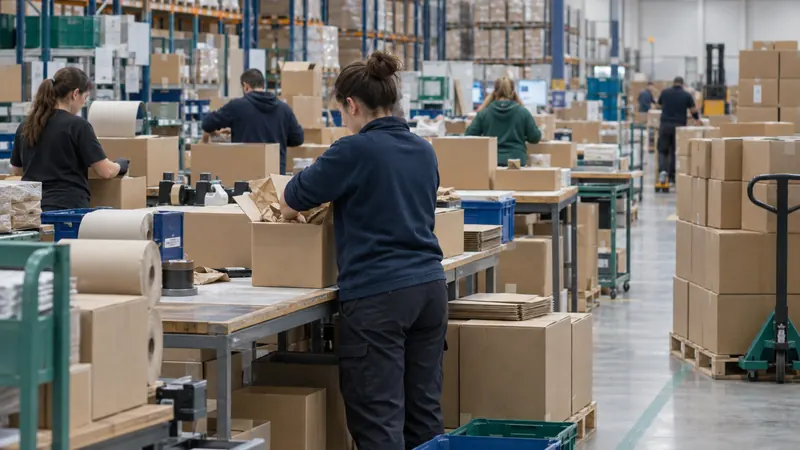
Between November and January, many warehouses in Mexico double their floor headcount with people who are new to the operation. Mexico's peak runs from El Buen Fin, the national sales event in mid-November, through Christmas and into January returns. The outcome of the season depends less on the number of people hired than on what they can do on day one and on the supervision they receive during the first week.
This article lays out a one-day training plan for seasonal staff and the legal and process conditions a US or international manager must resolve before they start.
Before training: the contract and who the employer is
Mexico's Federal Labor Law (Ley Federal del Trabajo) allows employment for a specific project, for a fixed term or for a season (article 35). A fixed term, however, can only be agreed when the nature of the work requires it or to temporarily replace another employee (article 37). A November-to-January increase in orders meets this condition; a "temporary" contract renewed throughout the year does not, and in Mexico an employment relationship without a valid term is presumed indefinite.
The bigger difference for US managers is staffing agencies. The April 2021 reform banned the subcontracting of personnel (article 12). An agency may recruit, screen and train, but the employer is the company that benefits from the work. Only specialized services that are not part of your company's core activity may be subcontracted, and only with a contractor registered in the Labor Ministry's public registry, known as REPSE (articles 13 to 15). If your company runs the warehouse, receiving, picking and shipping are part of its activity. Review the hiring model with Mexican labor counsel before you sign with an agency.
A temporary contract does not exempt the employer from training. Article 153-A requires the employer to train all workers, and article 153-V describes the skills certificate (commonly the DC-3 form) that documents a completed course.
What a new person needs to know on day one
A new hire does not need to know the whole warehouse, only to perform one position correctly. Before designing the training day, write a short list for each seasonal position (receiving, put-away, picking, packing, loading):
- Which task they receive and where it comes from.
- What they scan and in what order.
- What they do when there is a discrepancy.
- Whom they tell.
If the list for a position exceeds half a page, the position depends too heavily on memory. For peak season, simplify it: fewer variants, fewer exceptions and more decisions made by the supervisor.
The training day, hour by hour
A proposal for a group of six to ten people, with one trainer from the warehouse and one supervisor per position.
| Time | Block | Content |
|---|---|---|
| 8:00 to 9:00 | Safety induction | Evacuation routes, pedestrian aisles, forklifts, protective equipment, safe lifting |
| 9:00 to 9:45 | Walk-through | Zones, location codes, where goods are received, picked and packed |
| 9:45 to 10:30 | The device | Signing in, the task list, scanning, what each sound and message means |
| 10:30 to 13:00 | Guided practice by position | Real or practice tasks with real merchandise, paired with a permanent employee |
| 14:00 to 16:00 | Supervised practice | The person works alone; the supervisor checks each task at closing |
| 16:00 to 16:30 | Wrap-up | Questions, shift rules and whom to ask |
Do not shorten the safety induction
Mexico's standard on storing and handling materials with machinery, NOM-006-STPS-2023, in force since September 3, 2024, requires an induction course on warehouse safety for every new worker (section 10.1). It also states that each person may operate only the machinery for which they have been trained and authorized (section 6.5). Accordingly, seasonal staff do not operate forklifts or powered pallet jacks without documented training. US readers will recognize the logic from OSHA's powered industrial truck rule; the Mexican requirement sits in this standard.
Teach location codes on the floor
An explanation of "A-05-03-2 is zone A, aisle 5, rack 3, level 2" given in a classroom is quickly forgotten; it is retained better in front of the rack, with the label in view. If your warehouse lacks a clear naming scheme, the guide on location coding explains how to build one. That scheme must be in place before the season.
Three rules repeated all day
- Scan the location before picking or placing goods. The origin or destination of each unit is then recorded.
- Scan the product; do not type it. Manual entry of a code makes it easier to record the wrong item.
- Report every discrepancy and continue. A reported short pick is corrected in time; an unreported one becomes an inventory discrepancy that surfaces in January.
Week one: supervision and measurement
The training day qualifies a person to work; supervision during the first week ensures the quality of that work. Three practices are recommended:
- Pairs. Each seasonal hire works the first two days next to a permanent employee in the same position.
- Review at closing. The supervisor checks each person's first tasks before the goods move to the next step: a packed order, a put-away, a count.
- Process metrics. Track picking errors and short picks per day and per shift, not per person. Measuring the process finds where time and accuracy are lost without singling anyone out.
When the season ends, deactivate the users of departing staff on their last day. An active account for a person who no longer works for the company is an access risk and, in many systems, a paid license without use.
Why a guided process shortens training
Training is shorter when the process reduces what people must memorize. If the handheld shows the location, product, lot and quantity, and stops the task when an incorrect item is scanned, a new hire does not need to know the catalog or the building to pick correctly; reading the screen and scanning is enough.
In Chainlink WMS, each person signs in to the app with their own user and sees, in their task list, the receipts, put-aways, picks and counts assigned to them or available in their warehouse's shared queue. At shift change, each operator signs in with their own user, and work left in progress stays under the name of whoever started it. In guided picking, the app walks the picker through each pick and responds with a message when a different location is scanned or, with strict FEFO, a lot other than the allocated one. Deactivating a person blocks web and app access, frees their license and keeps their history. The Android app and the web platform are available in Spanish and English, so a bilingual team can work with the same process.
The Android app runs on Zebra and Honeywell handhelds with their built-in scanners and on phones with the camera, so devices can be added for the season without changing the process.
Frequently asked questions
Can a company in Mexico hire warehouse staff for the season only?
Yes. Mexican labor law allows seasonal and fixed-term employment when the nature of the work requires it. The contract form and its documentation should be defined by your labor counsel in Mexico.
Can a staffing agency be the employer of seasonal warehouse staff in Mexico?
Since 2021, subcontracting personnel is prohibited. An agency may recruit, screen and train, but the employer is the company that benefits from the work, except for specialized services outside its core activity provided by a contractor registered with the Labor Ministry.
How long does a new hire need to pick without errors?
It depends more on the process than on the person. With scan-guided picking, one day of practice is usually enough to work under supervision. Without scanning, learning depends on memorizing locations and products, and it takes longer.
Share this article: LinkedIn