Mexico regulates workplace safety through Official Mexican Standards (Normas Oficiales Mexicanas, NOM) issued by the Labor Ministry (STPS) and enforced through its inspections. For warehouses, the key one is NOM-006-STPS-2023, Storage and handling of materials with machinery: workplace safety conditions, published in the Official Gazette (DOF) on March 7, 2024 and in force since September 3, 2024, when it replaced NOM-006-STPS-2014. Many procedures still cite the 2014 version.
For US managers, it covers ground similar to OSHA's powered industrial truck and materials handling rules, but its requirements, wording and enforcement are Mexican. This article summarizes what it asks of a warehouse and how to organize compliance. For details and conformity assessment, refer to the full text and your safety and health officer in Mexico.
Who it applies to
Workplaces that store and handle materials with machinery: forklifts, conveyors, cranes, hoists, winches, front loaders or combinations of them. The standard defines storage as placing materials or containers in an orderly way on structures, shelves, platforms or stacks, with machinery or by hand. A warehouse with forklifts and racks is within its scope.
Employer obligations
Chapter 5 lists, among others:
- A review and maintenance program for the machinery, based on manufacturer recommendations and on time and intensity of use.
- Procedures for installing, operating, reviewing and maintaining machinery, and for emergencies.
- Safety measures for handling and storing materials.
- Supervision that work is done safely, including by contractors.
- Personal protective equipment according to the risks.
- A first-aid manual.
- Informing workers about the risks.
- Training.
- Records of machinery review and maintenance.
Workers, in turn, may operate only machinery for which they have been trained and authorized by the employer (section 6.5), and must report unsafe conditions immediately.
What it requires of storage areas
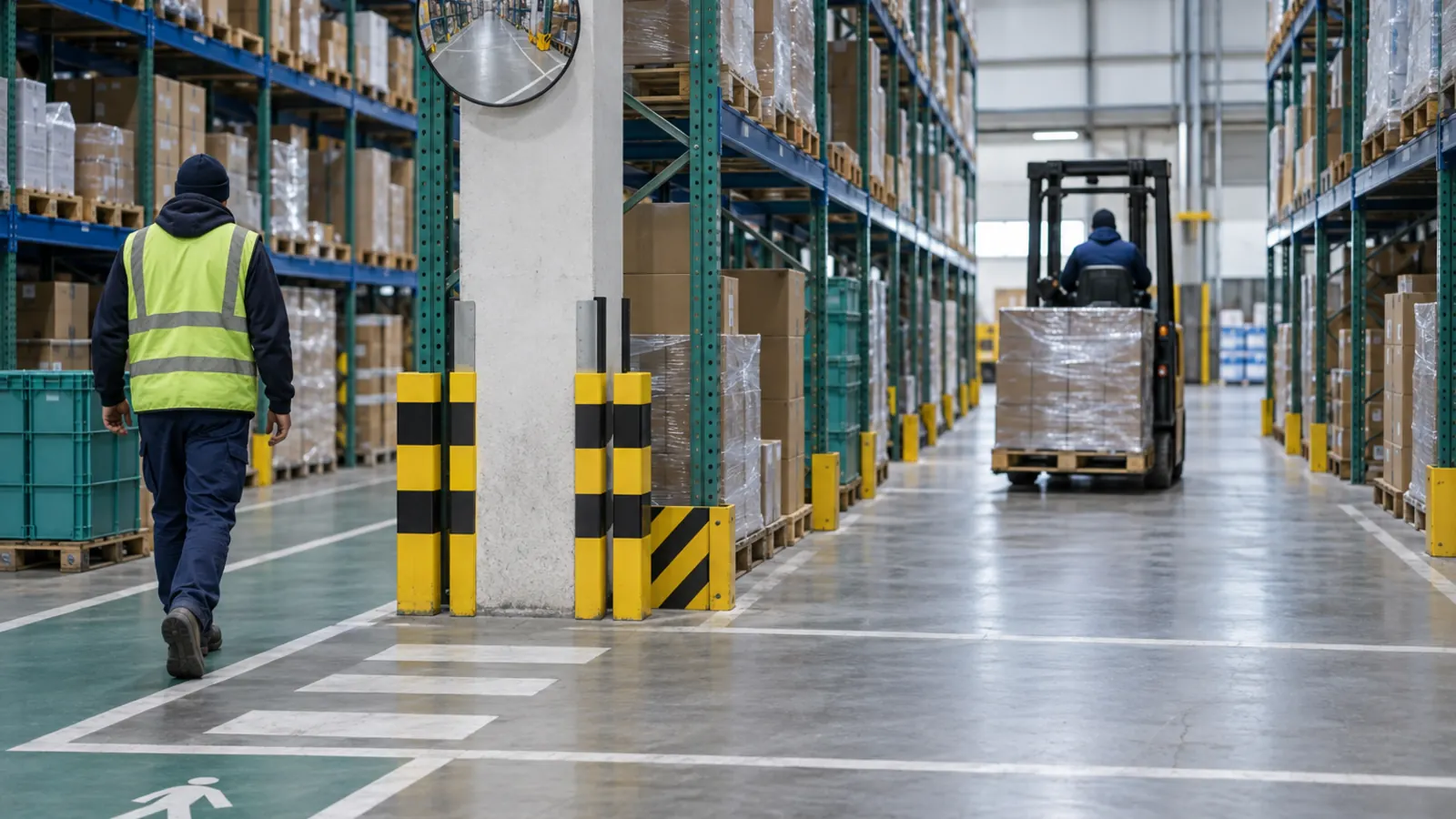
Section 9 matters most for warehouse design and housekeeping. Storage areas must have:
- Order and cleanliness.
- Firm, level floors strong enough for the weight of the stacks.
- Marked storage zones.
- Aisles whose width depends on the widest machinery or load that uses them and on the largest dimension of the materials.
- Ventilation and lighting suited to the work.
- Maximum load notices and the maximum number of products or boxes per stack on shelves and structures.
- Signage for maximum stack height, protective equipment, maximum vehicle speed, evacuation routes and emergency systems.
- Convex mirrors at aisle intersections where materials are higher than 1.8 m and vehicles travel.
When storing, among other conditions:
- Make sure racks and structures can bear the loads.
- Set the maximum stack height by the strength and shape of the material.
- Do not block lighting, ventilation, evacuation routes or fire equipment.
- Protect rack corners along vehicle routes with guards at least 30 cm (12 in) high, painted yellow or yellow with black stripes.
- On racks taller than 1.8 m, install back elements that keep materials from falling.
- Put the heaviest items at the bottom and unstack from the top.
The article on warehouse layout design shows how these requirements fit into the floor plan.
Training
Section 10 requires:
- An induction course for every new worker on safety conditions for storing and handling materials.
- Risk-prevention training for machinery operators, by task, and on emergency procedures.
- For operators, installers, maintenance staff and helpers: theory, hands-on practice and evaluation, covering how the machinery works, its capacities and limits, pre-shift checks and the conditions that require stopping work.
- Refreshers at least every two years, or sooner if new machinery arrives or procedures or areas change.
This is in addition to the general duty in Mexico's Federal Labor Law to train all workers (article 153-A).
How to organize compliance
- Machinery inventory: equipment, serial number, capacity, date of last review.
- Maintenance program with dates and signed records.
- Written procedures for operation, storage and emergencies, posted in the area.
- Area walk-through against the section 9 list: floors, zone marking, aisles, load notices, signage, mirrors, guards.
- Training matrix: who is authorized to operate which equipment, with dates of the last training and refresher. Keep it bilingual if supervisors from the US review it.
- Daily pre-shift check, recorded.
How Chainlink helps
Chainlink WMS does not manage the maintenance program or the training the standard requires. What it does is prevent the operation from using unsuitable locations: a location can be blocked with a reason, for example a damaged rack, and it stops being suggested for put-away and its stock stops being allocated to picks until it is unblocked. Zones have types that separate storage, picking, dock, packing, returns and quarantine, and each person sees in the app only the tasks their role allows.
Frequently asked questions
Is NOM-006-STPS-2014 still in force?
No. NOM-006-STPS-2023 replaced it and ended its effect on September 3, 2024.
How often must forklift training be refreshed in Mexico?
The standard requires refreshing training at least every two years, or sooner when new machinery is introduced, procedures change or work areas are modified.
At what height do the mirror and back-guard requirements apply?
The standard requires convex mirrors at intersections where materials exceed 1.8 m and back elements against falling materials on structures taller than 1.8 m.
Share this article: LinkedIn